The story of a system
A few weeks back, one of the hard drives in my computer started behaving erratically. Concerned it was going to fail, I took a full backup of it and removed it from the computer. The drive has been going since 2013 so it’s probably time for it to fail anyway but it got me thinking; the computer’s been around for a while, is it still set up as optimally as it could be?
My first attempt at building a computer was right back in my last year of university. I’ll admit I had no idea what I was doing; the majority of the components were donated by a close friend and all I did was put them inside a box. I had to buy a power supply unit and some disc drives, so I got a mid-range Corsair power supply and eventually a pair of 2TB discs for “future proofing”.
In late 2013 I decided to start again with my own components. I spent a lot of time comparing parts and picking out items that would make a decent everyday machine while keeping it quite future-proofed — I recall using the motto, “a decidedly mid-range machine” at the time. In January of 2014, I purchased the first parts of the new build: an Intel fourth-generation Core i7 processor and a motherboard to match. In February, I purchased a Corsair Obsidian 550D case — an oversized case with sound-dampening elements built in to make the resulting machine quieter than its predecessor. I took the graphics card, power supply and the two hard discs from the other machine and set the whole thing up as a brand new computer. This was the beginning of the machine I now call Skye.
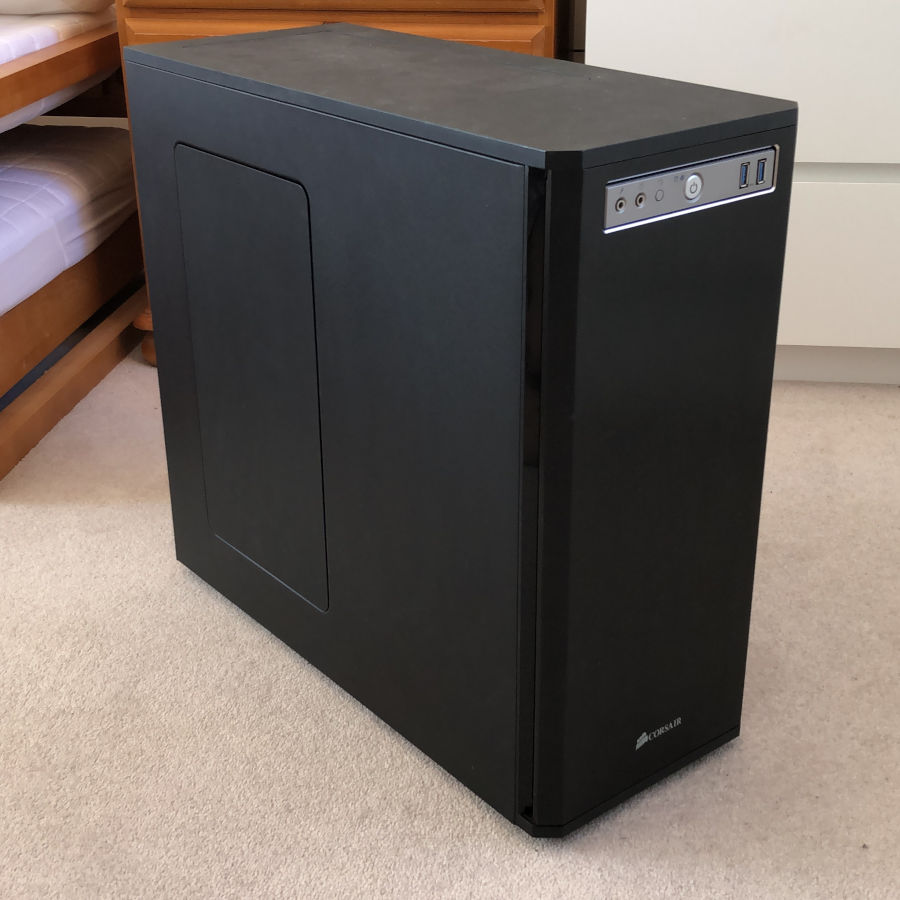
Skye has been with me through a lot since early 2014. Originally, she had no name other than “the Windows computer” and was the obscenely powerful companion to my laptop — in fact, I only really started calling her Skye when I replaced the laptop and called that Pulsar. While I still consider this computer the same one as the one I pieced together in 2014, there’s actually very little left which was present back then. The only parts that have been consistently used since Skye came into existence are the ridiculously oversized CPU cooler and, until recently, the power supply unit. She’s moved house three times, seen me take on several new roles at work and upgraded through several versions of Windows: one of which wiped both the hard discs and caused me to scrabble around with data recovery software for far longer than I wanted to. I’ve been quite impressed at how resilient and stable everything has been during this time, even with the minor replacements that have happened along the years.
I’ve also used some pieces of other machines for purely nostalgic reasons. When I was growing up there were two computers that I spent a lot of time with. The first was our family’s first computer: a fairly small, nondescript tower computer made by Fujitsu in 1996. The other was a dark blue Toshiba laptop which I used throughout high school. Screws and washers from these machines still hold together hard drive bays and secure the power supply mount.
In 2018 I built a Home Theatre PC (HTPC) to put under my TV using only second-hand parts. Unfortunately, the second-hand store where I purchased the components for this machine sent me an incorrectly-labelled processor that was far too powerful for the HTPC. Instead of sending it back, I decided to upgrade Skye using this processor – a first-generation AMD Ryzen 7. This kicked off a slow set of upgrades, culminating with a new case that I bought for myself last month.
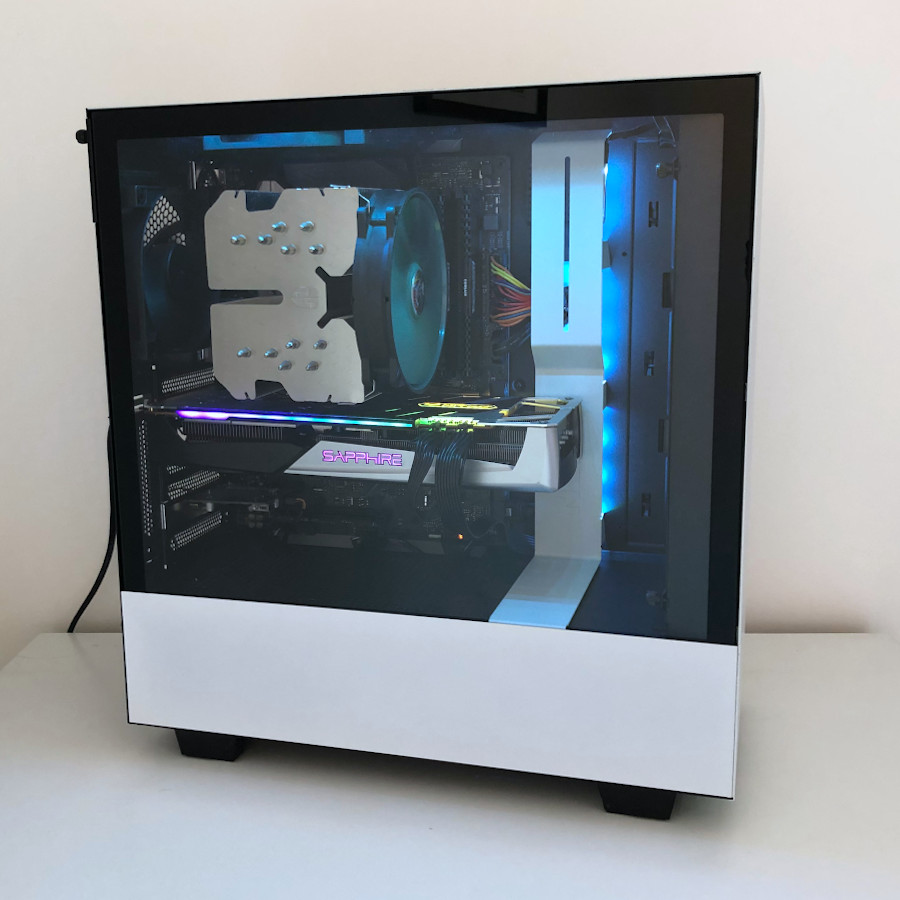
The old Corsair case was great for the amount of components I had originally. However the fact that I’ve upgraded almost everything meant not much of the case was being used any more – most of the hard drive bays left empty, the CD drive rack completely unused and most of the rear ports closed up. Therefore, I decided to splash out on a smaller case. I also wanted to show off the shiny elements I have acquired over the years – so I went for a second-hand NZXT H500i. It’s a bit smaller than the Corsair case and has far fewer moving parts, so I figured it would work better for this more focussed job.
I suppose that this is the machine that will be carrying me through the first part of this decade at the very least so I guess freshening it up a little over the past two years will keep it going for a while longer. The H500 case isn’t supposed to be good with airflow, but the temperatures seem to be pretty stable in the middle of the acceptable range! I’ve spent weeks tweaking the way everything works with each other to end up with a system that both looks and performs way above its league, at least according to benchmarking sites:
Overall this PC is performing above expectations (76th percentile). This means that out of 100 PCs with exactly the same components, 24 performed better. The overall PC percentile is the average of each of its individual components.
No longer “a decidedly mid-range machine” I guess!
Footnotes: